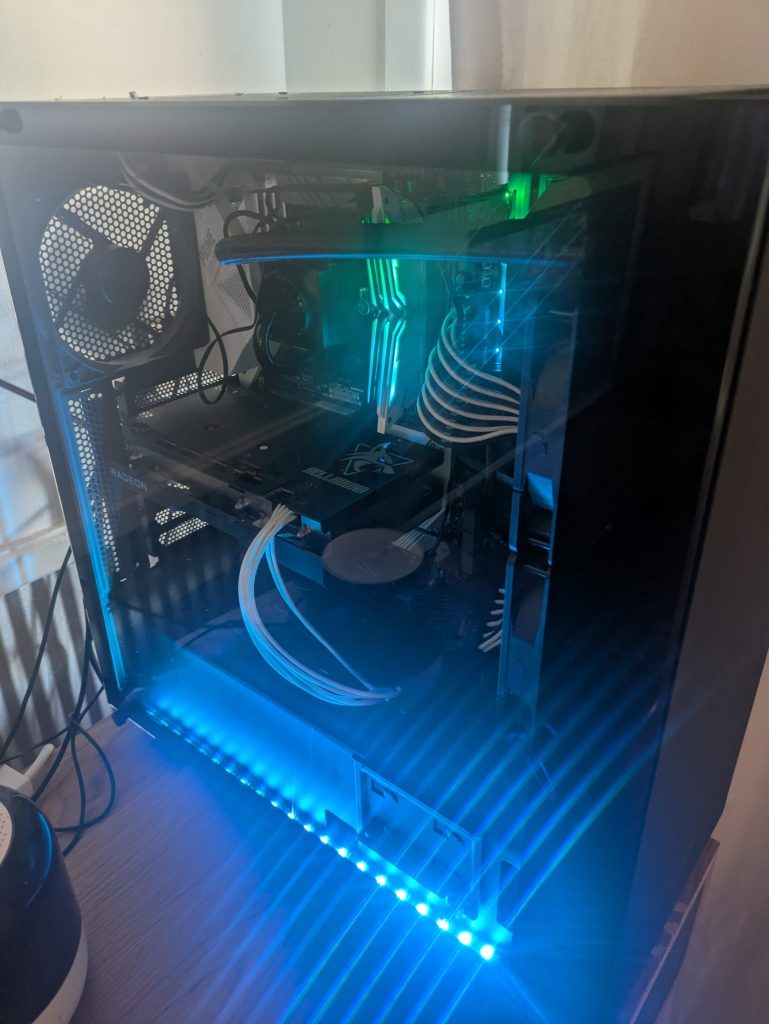
It started with a spark of curiosity. My six-year-old son began asking the question every modern parent eventually hears: “How do computers actually work?”, shortly followed by “I want my own computer!”. I decided this was a good teaching opportunity; let’s attempt to build our own computer. With the “Great RAM Crisis” of 2026 making new components eye-wateringly expensive, I couldn’t just walk into a store and buy components new. We needed a cheaper solution. We needed a project.
I found it on Facebook Marketplace: a “pile of scrap” for a mere $150 AUD. The seller could only tell us that it had an Intel i7-8700K and a GTX 1060, that there was something wrong with the motherboard, and all we had to go on were blurry pictures of a computer tower and a box of junk. To most, it looked like e-waste. To us, it looked like a puzzle.
The AI Vision Breakthrough
Being my first time ever building a PC, I was flying blind. Before embarking on the half-hour drive to pick up the parts, I used an LLMs “Vision” capabilities to see if the gamble was worth it. I uploaded the grainy Marketplace photos, and the AI acted as my scout. It successfully identified a high-end All-In-One (AIO) liquid cooler, a modern NVMe SSD stick, and four sticks of RAM. Knowing there was at least $300 worth of salvageable parts, we hit the road. The pickup was an adventure in itself—the sellers lived on a cucumber farm! They were incredibly kind, and we left not just with a box of electronics, but with a massive bag of fresh cucumbers—more than our family could ever hope to eat.
Forensic Troubleshooting & The “Rage-Quit” Theory
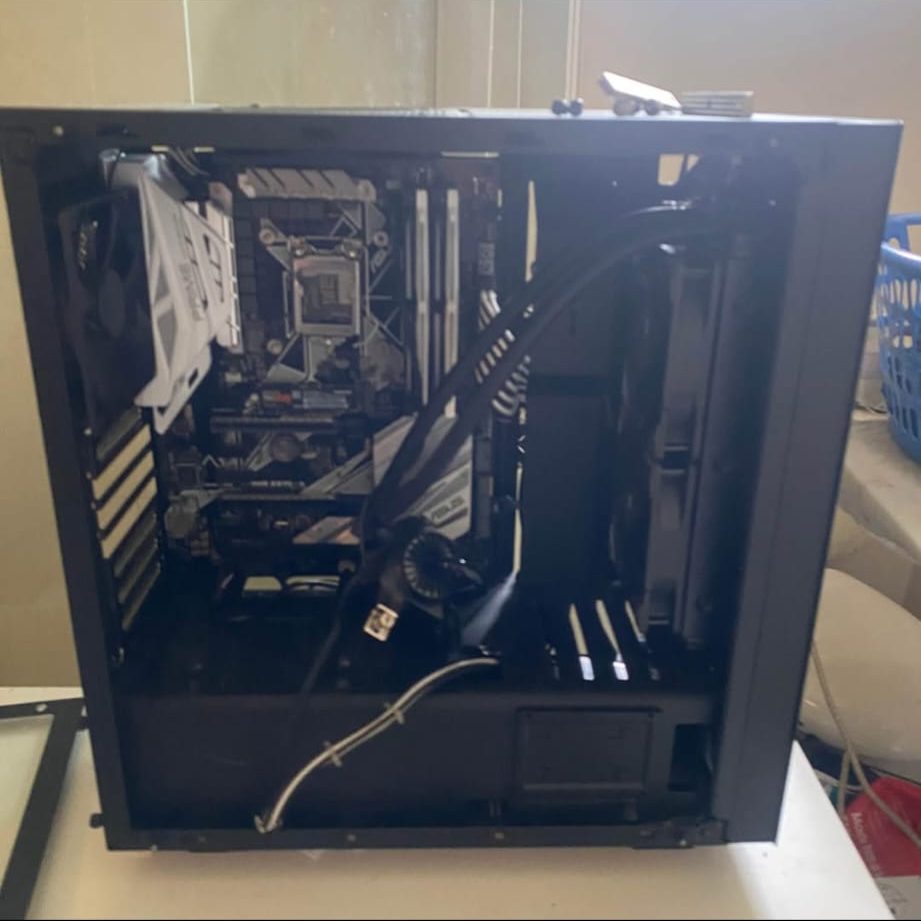
The reality of the “scrap” was grim. Once we got the haul home, we found a carnage of components: one of the four RAM sticks was stone-dead, the power supply (PSU) wouldn’t even fan-spin, and two different motherboards sat there with agonizingly bent socket pins.
Curious about how such gear ended up in a junk box, I asked the AI for a “forensic” hypothesis. It painted a perfect picture of a “High-End Disaster”: The previous owner likely suffered a failing PSU that sent a voltage spike through the RAM. In a frustrated attempt to swap motherboards and find the fault, they likely rushed the process, bending the pins on both boards. It was a classic hardware “rage-quit.”
The Learning Curve: Breadboarding and Surgery
The AI became our digital mentor. It walked us through “breadboarding”—testing components outside the case on a cardboard box to isolate the ghost in the machine. My son watched as I used a tiny needle to meticulously straighten the motherboard pins, a task the AI coached me through with surgical patience.
We eventually found the winning combination. By discarding the one dead RAM stick and using the replacement PSU that luckily came in the box, the machine finally flickered to life.
The Final Result
After hours of troubleshooting, we successfully rescued an Intel i7-8700K powerhouse. The only additional thing we needed to buy, after all the fixing was done, was a Wi-Fi / Bluetooth card to get it online.
This project proved that AI is the ultimate force multiplier for DIY. It turned a complete novice into a technician. My son didn’t just get a computer; he watched his dad turn “trash” into a high-performance machine. We built more than just a PC; we built a bridge between old-school hardware and next-gen AI assistance. For a fraction of the cost of a new console—and a side of fresh cucumbers—my son has a front-row seat to the digital world.
Why This Matters to Impact Engines
This story exemplifies something we at Impact Engines find fascinating: artificial intelligence is not confined to traditional software development or enterprise workflows. AI excels in helping us solve real-world, tangible problems – whether that is analyzing survey data for humanitarian organizations or guiding a parent through the practical challenges of rebuilding computer hardware.
What made this project work was not just access to a capable AI model, but thoughtful prompting and leveraging the right modalities. By uploading photos and using ‘vision’, the AI could see what a human expert would see – component quality, salvageability, value. This multimodal approach turned a gamble into informed decision-making.
At Impact Engines, we are constantly seeking interesting and practical use cases for AI that extend beyond typical chatbot applications. We explore how specialized AI – with good prompting, rich inputs, and the right architectural choices – can augment human capability across all walks of work and life. From development surveys to personal projects, the principle remains the same: better inputs and smarter prompting yield better outcomes.
This is the work we champion. Not AI for its own sake, but AI as a pragmatic tool for solving the problems people actually face.